
Clearfield Parole and Probation
Clearfield County Sheriff Chester Hawkins is not the custodian of county probation or PADOC parole records, so supervision checks go to the office responsible for the case.
Parole and probation can both place a released Clearfield County person under rules in the community, but they begin in different ways. The Pennsylvania Parole Board decides state parole after a state prisoner reaches eligibility. The Pennsylvania Department of Corrections, or PADOC, then performs field supervision. Clearfield County Adult Probation handles supervision ordered in local court cases. Its office is not the custodian of a state parole file.
Parole does not erase the unexpired sentence. It is conditional release before the maximum date. Probation is a court-imposed sentence that may follow confinement or may be ordered without it. A full discharge is different from both: discharge means the relevant term of supervision has ended. Home detention and work release are also distinct because a person outside a cell may remain under correctional control.
| Record type | How it begins | Clearfield verification source |
|---|---|---|
| State parole | Board-approved conditional release from a PADOC institution | PADOC supervised-person locator and parole office |
| County probation | Sentence imposed by a Clearfield County court | UJS docket and Clearfield County Adult Probation |
| County judicial parole | Local parole under the sentencing court's authority | Court record, jail record, and county supervision office |
| Discharge | End of the applicable sentence or supervision term | Final court, Board, or supervising-agency record |
- Minimum date
- The earliest ordinary state parole eligibility point, not a promised release date.
- Maximum date
- The sentence boundary subject to lawful credits, aggregation, recommitment, and later orders.
- Absconder
- A supervised person alleged to have stopped reporting as required; the label does not prove present incarceration.
- Detainer
- A hold or request from another authority that can affect custody even after one release decision.
Verify Clearfield Post-Release Supervision
Start with identity and jurisdiction. A name alone can join two different records. Gather the full legal name, date of birth, inmate or parole number when known, Clearfield docket or OTN, sentencing county, and last facility. The correct route depends on whether the sentence was state or county.
- Search the PADOC locator in Department Supervised Individual mode for a state parole case. Use a parole or inmate number when possible, then compare aliases, date of birth, county, district office, and physical details.
- Open the matching detail. Read its Release Date and Last Updated Time. That Release Date records departure into Department supervision; it is not a projected date or proof of maximum discharge.
- For a county case, search UJS Case Search at the proper Magisterial District Judge or Common Pleas level. Review sentencing, probation, county parole, revocation, warrant, and later modification entries.
- Use the PADOC parole-office directory for state supervision, or contact Clearfield County Adult Probation for a county sentence. Ask about the correct office and record, not for legal advice.
- If the sources conflict, contact the authority that created the disputed record. Distinguish actual prison release, current office, maximum discharge, and an alleged violation in the question.
For the larger custody-verification sequence and county release-record route, use the Clearfield County released inmate search. That path adds the jail, court, PA SAVIN, federal, and immigration checks when the last authority is uncertain.
Clearfield County Probation Office
The official Probation, Fines & Costs page identifies the local route for adult county supervision. The department reports that it monitors more than 2,000 clients each year and collects court-imposed fines, costs, and restitution. Those duties do not make its website a public person-search tool. A caller should cite the docket and ask which office holds the supervision record.
Clearfield County Adult ProbationCourthouse Annex, second floor
230 East Market Street
Clearfield, PA 16830
814-765-2641, extension 5009
Monday through Friday, 8:30 a.m. to 4 p.m.
The public page lists no online probationer database. Court records can show that probation was imposed, but a docket entry may not reflect every same-day office update. Contact the county department for routing and the Clerk for the filed order. State parole questions should instead follow the PADOC locator and parole-office directory.
Clearfield court records and supervision records should be used together. A docket can identify the sentence, term, and later order, while the probation office can identify the local administrative route. If the court record is unclear, cite the exact docket and OTN when asking the Clerk which filed probation, revocation, or discharge order is available. Court staff can explain access procedure but do not calculate a sentence or give legal advice.
Note: Juvenile supervision uses a separate county extension, and protected juvenile records should not be sought through adult public-record channels.
Clearfield Parole Violation Records
Conditions are requirements attached to supervision. The controlling order and supervising agency record govern them. Alleged failure to report may lead PADOC to label a state parolee an absconder. The official parole absconder page shows recently added entries and a View All route. It is a focused state supervision source, not a list of all released people in Clearfield County.
A warrant or absconder label needs precise wording. It can show that an authority seeks a person for an alleged supervision breach, but it does not prove the person has already returned to custody. Check the live label, its date, the court docket when relevant, and the responsible supervision office. PA SAVIN or VINELink may report a later custody event from a participating jail or prison, though it is not a general probation-status service.
The official parole-violation process explains the state route. County probation violations belong to the Clearfield court and probation file. Do not blend those two processes or treat a county bench warrant as a PADOC absconder entry.
The PADOC absconder route is shown below as a visual check of the state source.
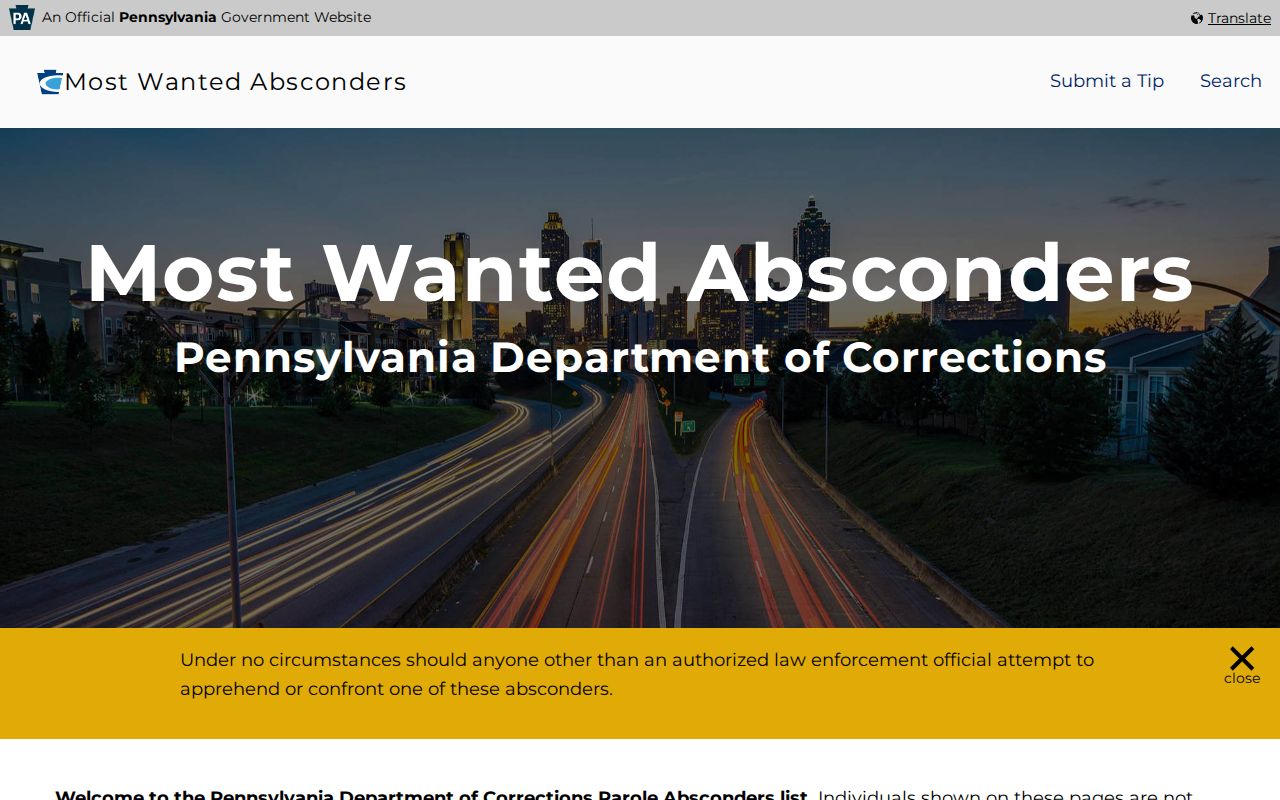
Use the page only when an absconder question is supported by a state supervision record, and confirm identity before relying on a name.
Clearfield Supervision and Discharge
Release from an institution and discharge from a sentence are separate milestones. The PADOC supervised-person Release Date is retrospective evidence that the person entered Department supervision. It does not show that the maximum sentence expired. County probation likewise can continue after a jail term ends. The filed sentencing order, later modification or revocation entries, and the supervising authority's final record provide the needed context.
Parole eligibility begins after the judicial minimum under Pennsylvania law, but there is no right to parole. A Board grant may precede physical departure while release-plan steps remain, and it can be rescinded before release. Pennsylvania also has no blanket rule requiring an ordinary prisoner to serve 85 percent of the maximum. Specialized RRRI eligibility does not guarantee release either.
To confirm the end of supervision, ask for the record that states discharge or sentence completion. Give the parole or inmate number for a PADOC inquiry and the docket or OTN for a Clearfield County case. Do not infer discharge from a missing search result, because data timing, record limits, aliases, sealing, or a different authority may explain the gap.
A supervision inquiry should also separate current status from historical action. A past parole grant, probation sentence, or violation entry does not by itself state what applies today. Note the source date, compare later orders, and ask the responsible Clearfield or state office to resolve any conflict. This keeps a former status from being mistaken for a current one.
Note: A Board action granting parole can precede the actual prison-door release and should not be substituted for the custodial event record.
Clearfield State Reentry Paths
Clearfield County has two distinct state-release resources. The SCI Houtzdale page identifies a Reentry Service Office for people within 18 months of a minimum or release date. The Bureau of Community Corrections directory lists Tomorrow's Hope in Coalport as a community contract facility. Neither source publishes a roll of released Clearfield residents.
A person can leave an SCI for parole and appear in PADOC's Department Supervised Individual mode. A resident at Tomorrow's Hope may still be serving a state sentence or remain under a structured parole placement. Departure from that building is not enough to label the person discharged. Read the PADOC status, release date, district office, and last update, then contact the listed parole office if the meaning is unclear.
These local points help identify the proper authority. SCI Houtzdale serves state inmates from across Pennsylvania, not just Clearfield cases. Tomorrow's Hope is not a county probation office. The court docket explains the sentence, while PADOC records the state custody and supervision event.
Identification After Clearfield Release
Clearfield's March 2026 Prison Board minutes recorded an identification problem affecting some people leaving county custody. The jail had begun issuing a photo ID bracelet, and officials discussed it as a possible response to an Area Transportation Authority identification rule. That discussion supports a local logistics warning, not a promise that a transit provider accepts the bracelet.
Someone preparing for a Clearfield County release should confirm current identification and transportation rules directly with the jail and provider. The minutes capture what officials discussed on that date. They do not establish a permanent policy or guaranteed ride. Identification logistics also do not indicate whether parole or probation has started; the court and supervising agency records answer that separate question.
Note: The 2026 bracelet discussion was a proposed practical response and did not document a standing ATA acceptance policy.